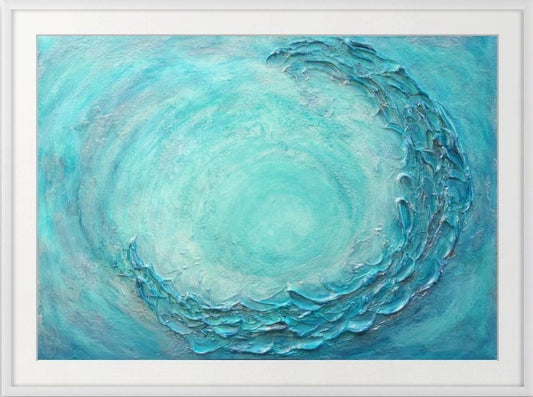
Women Artists excluded from History 3; Joan Mitchell, a fierce abstract painter sidelined by a patriarchal system
This is my third piece specifically focused on female artists whose work had been side-lined in favour of the male 'artistic genius'.
Joan Mitchell (1925–1992) made some of the most powerful, large-scale abstract paintings of the postwar era. Her canvases are dense with gesture, colour and emotion, paintings that read like landscapes remembered and transposed through music and memory. Yet for decades, the institutions, critics and marketplace that decided whose work mattered treated her, and many women artists like her, as afterthoughts or marginal players. This was not an accident. It was part of a broader, gendered cultural machine that celebrated a romanticised masculine genius and made it hard for women to be seen as equal creative force.
There is just one image I can legally use to represent Joan's work.
Joan Mitchell, Untitled, before 1956, oil on paper, sheet: 26 x 20 in. (66.0 x 50.8 cm), Smithsonian American Art Museum, Bequest of Florence Coulson Davis, 2000.9.1

Mitchell trained at the Art Institute of Chicago and then in New York with Hans Hofmann, arriving in the city as Abstract Expressionism coalesced. She was an early and original voice in that movement. Her work moved from small, intense “Little Images” to the vast, working canvases for which she is best known. She painted with the urgency and stamina of someone composing music in colour; critics and peers noted her synesthetic approach, she often described painting in terms of music and landscape.
Yet while her peers (male and female) were building reputations, the institutional narrative of the New York School was written around certain male figures. The art world loved the myth of the solitary heroic male painter and the dramatic stories that fed that myth. Women who painted with equal intensity were too often described through domestic or relational lenses rather than as makers in their own right. Even though Mitchell enjoyed critical respect in some quarters, the broader market and many histories packaged her as “one of the women painters” rather than a central architect of postwar abstraction. Curators and collectors often framed her work in relation to landscapes and lyricism in a way that softened or domesticated the radical edge of her practice.
The institutional correction has been slow. In recent years there has been a visible reappraisal of Mitchell’s work. Major museums and exhibitions have restaged her career with the seriousness it deserves. Museums now hold major Mitchell works and have mounted retrospectives and centenary programming that reposition her as a commanding modernist, not a marginal figure. In 2025 the Tate announced a major donation of a monumental Mitchell triptych to its national collection, underlining how museums are actively rewriting the canon to include work that was previously undervalued.
Why does this matter beyond art-history trivia? Because the patterns that consigned Mitchell to a secondary status were structural. Gatekeepers shaped which artists received critical essays, solo shows, gallery investment and market support. Women artists often did the same demanding, experimental work as men but were not given the same platforms or the same mythic narratives. Mitchell persistently defied the expectations placed on women painters: she painted big, refused to be passive, and kept evolving stylistically over decades instead of settling into a market-friendly “signature” look. That resistance to being packaged was itself a rebuke to the patriarchal pressures of the market and press.
Today, Joan Mitchell’s paintings command major exhibitions and fetch multimillion-dollar prices. That market rectification is welcome, but it arrives later than it should have. It is also a reminder that recognition is not only about merit; it is about access to networks and institutional attention. Reclaiming Mitchell’s place helps us see how many other women were crowded out by the stories that conferred cultural capital on men.
Sources & further reading:
- Joan Mitchell Foundation, artist overview and artwork index.
- MoMA, Joan Mitchell artist page and collection entries.
- The Metropolitan Museum of Art — object pages for La Vie en Rose and Sunflower.
- Tate / ArtNet coverage of the 2025 donation and reassessment.
- Christie's, Frieze and other contemporary coverage of Mitchell’s centenary and market reappraisal.