Science Has Finally Caught Up With What Art Lovers Always Knew
There has always been something people struggle to put into words about standing in front of a painting that moves them. A physical shift, a relaxing and a sense that something in the room, and something in you, has changed.
It turns out that feeling is not imaginary. It is measurable. And a landmark study published in October 2025 has produced the most compelling scientific evidence to date that looking at original art has immediate, real and significant benefits for your body.
Not over weeks or with repeated visits, but immediately.

The Study
The research was conducted by King's College London's Institute of Psychiatry, Psychology and Neuroscience, in partnership with Art Fund, the UK's national charity for museums and galleries, and the Psychiatry Research Trust. It took place between July and September 2025 at The Courtauld Gallery in London, one of the UK's most celebrated art collections and home to extraordinary works by Manet, Van Gogh and Gauguin.
Fifty volunteers aged 18 to 40 were divided into two groups. The first group spent approximately 20 minutes viewing original masterworks at The Courtauld. The second group viewed reproductions of the exact same paintings in a matched, non-gallery environment. Participants wore research-grade digital wrist sensors throughout, measuring heart rate variability and skin temperature in real time. Saliva samples were taken before and after to measure cortisol and key inflammatory markers.
The results genuinely surprised the researchers.

What They Found
Cortisol fell by 22% in the group viewing original art. The same measure for the group viewing reproductions? Just 8%. The gap between standing in front of an original painting and looking at a copy of it is not a matter of taste or preference. It is a 22% versus 8% reduction in your body's primary stress hormone.
Pro-inflammatory proteins dropped by nearly a third. Two specific inflammatory markers, IL-6 and TNF-alpha, which are linked to stress and a wide range of chronic diseases including heart disease, diabetes, anxiety and depression, fell by 30% and 28% respectively in the gallery group. No changes were observed in the reproduction group.
Art activated three body systems simultaneously, the immune system, the endocrine (hormonal) system, and the autonomic nervous system all at the same time. Dr Tony Woods, the lead researcher at King's College London, described this as "a unique finding and something we were genuinely surprised to see." To his knowledge, no single activity had previously been shown to engage all three systems at once.
Heart activity became more dynamic in those viewing original art, indicating that the experience simultaneously relaxed and aroused the body in a balanced, healthy way. The body was not simply switching off. It was engaging fully, in a way that is physiologically distinct from passive rest.
Critically, the researchers also found that neither personality traits nor emotional intelligence influenced the results. The health benefits were universal across participants. You do not need to be an art lover, a regular gallery visitor, or someone with any particular cultural knowledge to experience them.

Why Original Art Specifically?
This is the finding that I keep coming back to.
The study went to considerable lengths to isolate the variable. The same paintings. The same viewing duration. The only difference was whether participants were looking at the original or a reproduction. And the results were unambiguous: the original produced dramatically greater physiological benefit.
The researchers suggest that viewing art in person provides a full sensory and emotional experience, scale, texture, brushwork, lighting, atmosphere that simply cannot be replicated through a screen or a printed reproduction. There is something in the physical presence of an original work that triggers a response in the body that a copy does not.
As Dr Woods put it: "The fact that viewing original art lowered these markers suggests that cultural experiences may play a real role in protecting both mind and body."
What This Means if You Have Art on Your Wall
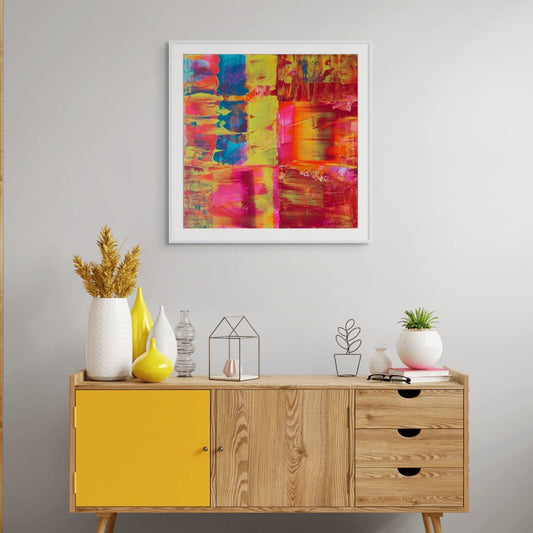
The Courtauld study measured the experience of visiting a gallery. But consider what it means to live with original art in your home.
A gallery visit lasts 20 minutes. You walk past a painting in your hallway every morning. You sit across from a canvas in your living room every evening. The cumulative effect of regular proximity to original art, over months and years, has not yet been fully studied but the direction of travel in the research is clear. The body responds to original art in a way it does not respond to reproductions. And it responds immediately.
The conversation about art has always centred on beauty, on meaning, on investment. This study adds something new to that conversation: art is good for you in the same way sleep and exercise are good for you. Not metaphorically but very much measurably so.

A Note From Me
I have always believed, in the way that most artists believe things, that making art and living with art is connected to something essential about being human. Not as a luxury but as an absolute need.
I did not expect science to confirm that quite so precisely but I'm so delighted it has.
If you have been thinking about bringing an original painting or a quality limited edition print into your home, I hope this gives you one more reason to trust that instinct. Not because you need a scientific justification for surrounding yourself with things that move you. But because it is genuinely good to know that the thing you already felt is real.
Browse the collection at juliebevanart.com
Sources
King's College London (October 2025). The Physiological Impact of Viewing Original Artworks vs. Reprints: A Comparative Study. Institute of Psychiatry, Psychology and Neuroscience. Published at kcl.ac.uk
The Courtauld Gallery (October 2025). First-of-its-kind study proves positive impact of art on the body. courtauld.ac.uk
Artsy (October 2025). Looking at art reduces stress, according to UK scientific study. artsy.net
Smithsonian Magazine (November 2025). Can Visiting an Art Gallery Lower Your Stress Levels and Improve Your Health? smithsonianmag.com